11.12. ITK Binary Opening By Reconstruction Image Filter
Removes small foreground objects from a binary image while preserving the exact shape of the objects that remain.
Group (Subgroup)
ITKBinaryMathematicalMorphology (BinaryMathematicalMorphology)
Description
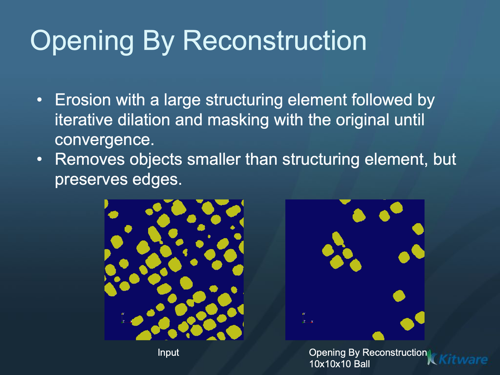
Like a standard morphological opening, this filter removes foreground objects that are smaller than the structuring element (the small probe shape — a ball, box, etc. — that is swept over the image). Unlike a plain opening, it then uses morphological reconstruction to restore the surviving objects to their original shape.
A plain opening erodes (shrinks) the image and then dilates (regrows) it. The erosion deletes small objects, but it also rounds off and shrinks the corners of the larger objects that survive. Opening by reconstruction avoids that side effect: after the erosion deletes the small objects, the reconstruction step regrows each surviving object back to exactly its original boundary instead of the rounded, dilated approximation. The net effect is “delete the small objects, leave the rest untouched.”
The result is defined as Opening(f) = ReconstructionByDilation(Erosion(f)).
Parameter Guidance
Foreground Value — the pixel value that counts as object/foreground (everything else is background). For a segmented or thresholded image, this is the label of the region to process.
Background Value — the value written where foreground is removed.
Kernel Radius — the radius of the structuring element, in pixels (one value per axis). Objects smaller than this are removed.
Fully Connected — controls neighbor connectivity during reconstruction (face-only versus face + edge + corner). Turn it on for thin, one-pixel-wide features.
Kernel Type
The Kernel Type parameter selects the structuring element shape:
Annulus [0]: A ring-shaped structuring element.
Ball [1]: A spherical structuring element (default). Most commonly used for general morphological operations.
Box [2]: A rectangular/cuboid structuring element.
Cross [3]: A cross-shaped structuring element.
Required Input Sources
Operates on a binary/segmented image — typically the output of a thresholding filter such as ITK Binary Threshold Image Filter or Multi-Threshold Objects. Compare with the standard ITK Binary Morphological Opening Image Filter, which does not preserve object shape.
Input Parameter(s)
Parameter Name |
Parameter Type |
Parameter Notes |
Description |
|---|---|---|---|
Kernel Radius |
Vector of UInt32 Values |
Order=X,Y,Z |
The radius of the kernel structuring element. |
Kernel Type |
Choices |
Set the kernel or structuring element used for the morphology. |
|
Foreground Value |
Scalar Value |
Float64 |
Set the value in the image to consider as ‘foreground’. Defaults to maximum value of PixelType. |
Background Value |
Scalar Value |
Float64 |
Set the value in eroded part of the image. Defaults to zero |
Fully Connected |
Bool |
Set/Get whether the connected components are defined strictly by face connectivity or by face+edge+vertex connectivity. Default is FullyConnectedOff. For objects that are 1 pixel wide, use FullyConnectedOn. |
Input Cell Data
Parameter Name |
Parameter Type |
Parameter Notes |
Description |
|---|---|---|---|
Image Geometry |
Geometry Selection |
Image |
Select the Image Geometry Group from the DataStructure. |
Input Cell Data |
Array Selection |
Allowed Types: int8, uint8, int16, uint16, int32, uint32, int64, uint64 |
The image data that will be processed by this filter. |
Output Cell Data
Parameter Name |
Parameter Type |
Parameter Notes |
Description |
|---|---|---|---|
Output Cell Data |
DataObjectName |
The result of the processing will be stored in this Data Array inside the same group as the input data. |
Example Pipelines
License & Copyright
Please see the description file distributed with this Plugin
DREAM3D-NX Help
If you need help, need to file a bug report or want to request a new feature, please head over to the DREAM3DNX-Issues GitHub site where the community of DREAM3D-NX users can help answer your questions.