11.61. ITK Otsu Multiple Thresholds Image Filter
Automatically separates an image into several intensity classes using Otsu’s method and writes a label map.
Group (Subgroup)
ITKThresholding (Thresholding)
Description
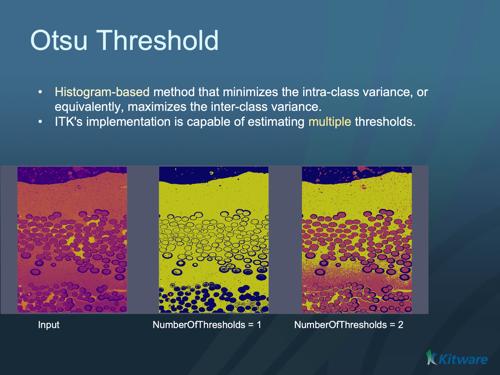
Otsu thresholding automatically chooses threshold values from the image’s intensity histogram — it picks the thresholds that best separate the pixels into distinct classes by maximizing the variance between classes (equivalently, minimizing the variance within each class). No threshold intensities are entered by hand; the filter computes them for you.
This filter is the multi-level version: instead of one threshold (two classes), it finds N thresholds that partition the image into N + 1 classes. The output is a label map in which each pixel is assigned an integer class index (0, 1, 2, …) according to which intensity band it falls into.
Use this filter when an image contains several distinguishable intensity populations (for example background, matrix, and one or more phases) and you want them segmented into labels without manually tuning cutoffs.
Parameter Guidance
Number Of Thresholds — how many thresholds to compute. The output contains one more class than this number (N thresholds → N + 1 labels). Default 1 (two classes).
Number Of Histogram Bins — the number of bins used to build the intensity histogram the thresholds are computed from. More bins give finer threshold resolution at the cost of speed; default 128.
Label Offset — an integer added to every output label so the classes start from a value other than 0 (useful for keeping labels distinct from other label maps). Default 0.
Valley Emphasis — when on, biases the threshold selection toward the valleys (low-population dips) of the histogram. This helps when the object of interest is small and would otherwise be lost against a large background population. Default off.
ReturnBinMidpoint — when on, each computed threshold is reported as the midpoint of its histogram bin; when off (default), the bin’s maximum value is used.
Required Input Sources
Operates on any scalar image — typically from Read Image, Read Images [3D Stack], or the output of a prior ITK image filter.
Input Parameter(s)
Parameter Name |
Parameter Type |
Parameter Notes |
Description |
|---|---|---|---|
Number Of Thresholds |
UInt8 |
Set/Get the number of thresholds. Default is 1. |
|
Label Offset |
UInt8 |
Set/Get the offset which labels have to start from. Default is 0. |
|
Number Of Histogram Bins |
Scalar Value |
UInt32 |
Set/Get the number of histogram bins. Default is 128. |
Valley Emphasis |
Bool |
Set/Get the use of valley emphasis. Default is false. |
|
ReturnBinMidpoint |
Bool |
Should the threshold value be mid-point of the bin or the maximum? Default is to return bin maximum. |
Input Cell Data
Parameter Name |
Parameter Type |
Parameter Notes |
Description |
|---|---|---|---|
Image Geometry |
Geometry Selection |
Image |
Select the Image Geometry Group from the DataStructure. |
Input Cell Data |
Array Selection |
Allowed Types: int8, uint8, int16, uint16, int32, uint32, int64, uint64, float32, float64 |
The image data that will be processed by this filter. |
Output Cell Data
Parameter Name |
Parameter Type |
Parameter Notes |
Description |
|---|---|---|---|
Output Cell Data |
DataObjectName |
The result of the processing will be stored in this Data Array inside the same group as the input data. |
Example Pipelines
License & Copyright
Please see the description file distributed with this Plugin
DREAM3D-NX Help
If you need help, need to file a bug report or want to request a new feature, please head over to the DREAM3DNX-Issues GitHub site where the community of DREAM3D-NX users can help answer your questions.