12.3. Compute Average C-Axis Orientations
Group (Subgroup)
Statistics (Crystallography)
Description
This Filter computes the average C-axis direction for each Feature (grain) in hexagonal materials. The result is a unit vector per Feature that indicates where the grain’s C-axis points in the sample reference frame.
What is the C-Axis?
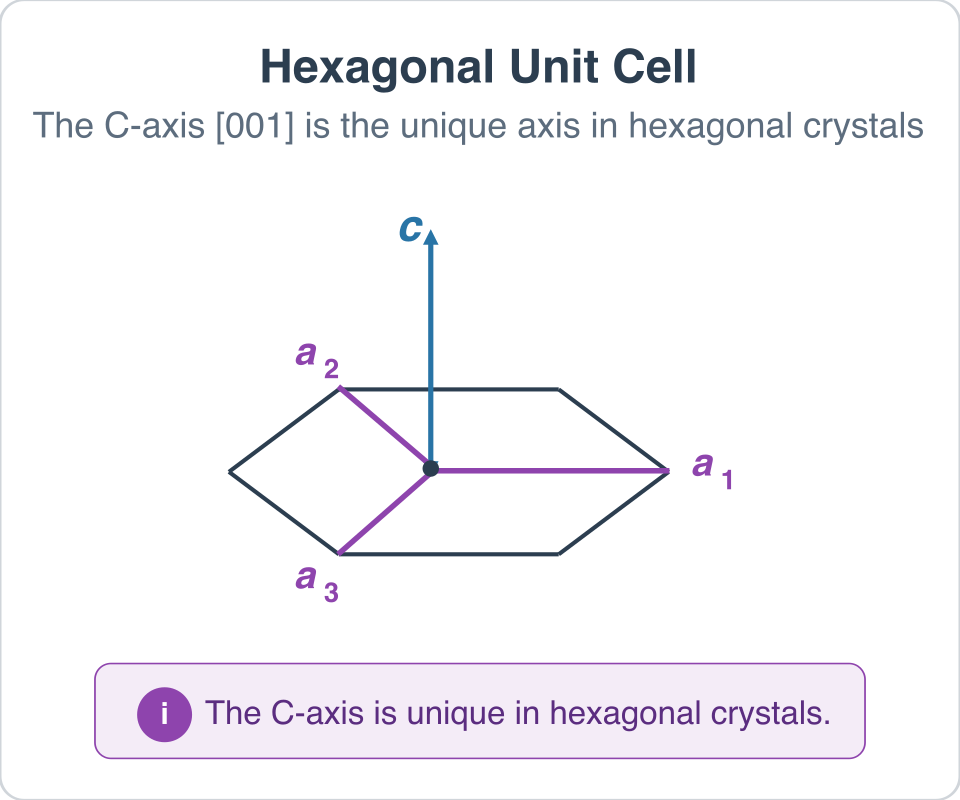
In hexagonal crystal structures (such as titanium, magnesium, and zinc), the C-axis is the unique crystallographic direction that runs along the long axis of the hexagonal unit cell (the [001] direction). This axis is important because many mechanical and physical properties of hexagonal materials vary depending on whether they are measured along or perpendicular to the C-axis.
How This Filter Works
Each Cell (voxel) in a grain has its own measured orientation. This filter determines where each cell’s C-axis points in the physical sample coordinate system, then averages those directions across all cells belonging to the same Feature:
For each Cell, the filter uses the cell’s orientation (quaternion) to rotate the crystal [001] direction into the sample reference frame.
The rotated C-axis directions are accumulated for each Feature, ensuring all directions point into the same hemisphere for a consistent average.
The accumulated directions are normalized to produce a unit vector for each Feature.
Hexagonal Materials Only
This filter only produces valid results for hexagonal phases (6/mmm or 6/m symmetry). In hexagonal materials, the C-axis is unique – there is only one [001] direction, so crystal symmetry does not create ambiguity.
In cubic materials, the [001], [010], and [100] directions are all crystallographically equivalent. Applying symmetry operators would move the [001] direction to different positions in the sample frame, making a simple average meaningless. For this reason, non-hexagonal phases will have their output values set to NaN.
The filter will produce an error if no hexagonal phases are present in the data.
Required Input Sources
This filter operates on previously segmented data and requires that several prior operations have already been run:
Cell Quaternions – typically read from EBSD data via Read H5EBSD, Read CTF Data, or Read ANG Data; can also be produced from Euler angles by Convert Orientations.
Cell Feature Ids – produced by a segmentation filter such as Segment Features (Misorientation) or Segment Features (C-Axis Misalignment).
Cell Phases – typically read from EBSD data alongside the quaternions.
Crystal Structures – ensemble-level array read from EBSD data or created by Create Ensemble Info.
Input Cell Data
Parameter Name |
Parameter Type |
Parameter Notes |
Description |
|---|---|---|---|
Cell Quaternions |
Array Selection |
Allowed Types: float32 Comp. Shape: 4 |
Input quaternion array |
Cell Feature Ids |
Array Selection |
Allowed Types: int32 Comp. Shape: 1 |
Data Array that specifies to which Feature each Element belongs |
Cell Phases |
Array Selection |
Allowed Types: int32 Comp. Shape: 1 |
Specifies to which Ensemble each Cell belongs |
Input Feature Data
Parameter Name |
Parameter Type |
Parameter Notes |
Description |
|---|---|---|---|
Feature Attribute Matrix |
AttributeMatrixSelection |
The path to the cell feature attribute matrix |
Input Ensemble Data
Parameter Name |
Parameter Type |
Parameter Notes |
Description |
|---|---|---|---|
Crystal Structures |
Array Selection |
Allowed Types: uint32 Comp. Shape: 1 |
Enumeration representing the crystal structure for each Ensemble |
Output Feature Data
Parameter Name |
Parameter Type |
Parameter Notes |
Description |
|---|---|---|---|
Average C-Axes |
DataObjectName |
The output average C-Axis values for each feature |
Example Pipelines
EBSD_Hexagonal_Data_Analysis
License & Copyright
Please see the description file distributed with this Plugin
DREAM3D-NX Help
If you need help, need to file a bug report or want to request a new feature, please head over to the DREAM3DNX-Issues GitHub site where the community of DREAM3D-NX users can help answer your questions.