12.39. Read EDAX EBSD Data (.ang)
Group (Subgroup)
IO (Input)
Description
This Filter will read a single .ang file into a new Image Geometry, allowing the immediate use of Filters on the data instead of having to generate the intermediate .h5ebsd file. A Cell Attribute Matrix and Ensemble Attribute Matrix will also be created to hold the imported EBSD information. Currently, the user has no control over the names of the created Attribute Arrays. The user should be aware that simply reading the file then performing operations that are dependent on the proper crystallographic and sample reference frame will be undefined or simply wrong. In order to bring the crystal reference frame and sample reference frame into coincidence, rotations will need to be applied to the data.
Created Data
The Image Geometry dimensions come from the NCOLS_EVEN/NROWS header values, the spacing from XSTEP/YSTEP (Z spacing is 1.0), the origin is (0, 0, 0), and the length units are always micrometers.
Location |
Array |
Type |
Notes |
|---|---|---|---|
Cell |
EulerAngles |
float32 (3) |
phi1, PHI, phi2 columns interleaved, in radians as stored in the file |
Cell |
Phases |
int32 |
Phase values less than 1 (un-indexed points) are remapped to 1 |
Cell |
Image Quality, Confidence Index, SEM Signal, Fit, X Position, Y Position |
float32 |
Copied verbatim from the file columns |
Ensemble |
CrystalStructures |
uint32 |
From each phase’s TSL |
Ensemble |
MaterialName |
string |
Whitespace-trimmed material name; index 0 is “Invalid Phase” |
Ensemble |
LatticeConstants |
float32 (6) |
a, b, c (Angstroms), alpha, beta, gamma (degrees); index 0 is all zeros |
Note on Length Units
The created Image Geometry is always marked as micrometers, matching standard EDAX SEM-based .ang files. Legacy DREAM.3D 6.5 detected certain retired TEM/ACOM .ang variants and marked them as nanometers; EDAX retired those file formats over a decade ago and this filter does not special-case them. If you are importing such an archival file, set the geometry units manually after import.
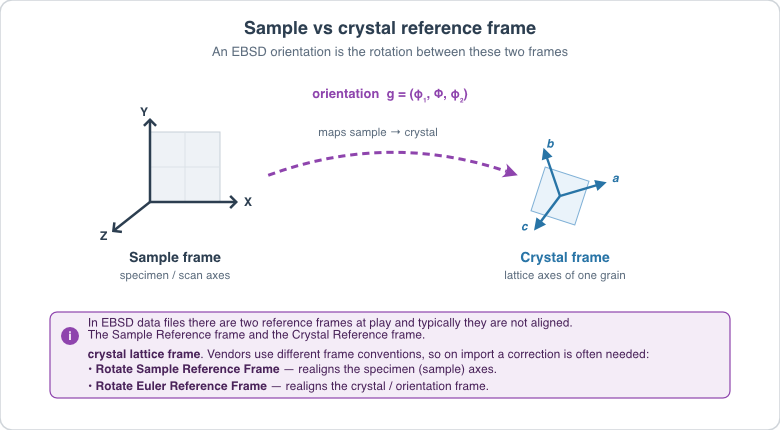
Default TSL Transformations
If the data has come from a TSL acquisition system and the settings of the acquisition software were in the default modes, the following reference frame transformations may need to be performed based on the version of the OIM Analysis software being used to collect the data. These rotations can be applied with Rotate Sample Reference Frame and Rotate Euler Reference Frame:
Sample Reference Frame: 180o about the <010> Axis
Crystal Reference Frame: 90o about the <001> Axis
The user also may want to assign un-indexed pixels to be ignored by flagging them as “bad”. The Multi-Threshold Objects filter can be used to define this mask by thresholding on values such as Confidence Index > 0.1 or Image Quality > desired quality. Confidence Index and Image Quality are per-pixel metrics that describe how reliable each individual measurement is.
Note About Sample Grid
OIMAnalysis can create EBSD data sampled on a hexagonal grid. The user can look in the .ang file into the header (those lines starting with the “#” character) for a line that is:
# GRID: HexGrid
If the user’s .ang files are hexagonal grid files then they will need to run the Convert EDAX Hex Grid to Square Grid (.ang) filter first to convert the input files to square-gridded files. This filter rejects hexagonal grid files during preflight with error -19500.
Downstream Processing
Once the reference frames are correct, the imported Euler angles are typically converted to other orientation representations (quaternions, and so on) with Convert Orientation Representation before computing misorientations, segmenting grains, or generating pole figures.
Required Input Sources
None — this filter reads directly from a .ang file on disk.
Note on .ang file Data Ordering
These are the order of the fields for each line in the data section of the .ang file.
phi1
Phi
phi2
x pos
y pos
image quality
confidence index
phase
SEM Signal
Fit of Solution
Input Parameter(s)
Parameter Name |
Parameter Type |
Parameter Notes |
Description |
|---|---|---|---|
Input File |
FileSystemPath |
The input .ang file path |
Output Image Geometry
Parameter Name |
Parameter Type |
Parameter Notes |
Description |
|---|---|---|---|
Image Geometry |
DataGroupCreation |
The path to the created Image Geometry |
Output Cell Attribute Matrix
Parameter Name |
Parameter Type |
Parameter Notes |
Description |
|---|---|---|---|
Cell Attribute Matrix |
DataObjectName |
The name of the cell data attribute matrix for the created Image Geometry |
Output Ensemble Attribute Matrix
Parameter Name |
Parameter Type |
Parameter Notes |
Description |
|---|---|---|---|
Ensemble Attribute Matrix |
DataObjectName |
The Attribute Matrix where the phase information is stored. |
Example Pipelines
Read_EDAX_Ang_File
Edax_IPF_Colors
CI_Histogram
EBSD_Hexagonal_Data_Analysis
ReplaceElementAttributesWithNeighbor (SimplnxCore)
ExtractVertexGeometry (SimplnxCore)
ApplyTransformation_Image (SimplnxCore)
Differences from DREAM.3D 6.5
Behavioral differences from the legacy ReadAngData filter (material-name trimming, length-unit handling for retired TEM/ACOM files, error-code changes, and a legacy crash on non-contiguous phase indices) are documented in the source tree at src/Plugins/OrientationAnalysis/vv/deviations/ReadAngDataFilter.md.
License & Copyright
Please see the description file distributed with this Plugin
DREAM3D-NX Help
If you need help, need to file a bug report or want to request a new feature, please head over to the DREAM3DNX-Issues GitHub site where the community of DREAM3D-NX users can help answer your questions.