12.4. Compute C-Axis Locations
Group (Subgroup)
Statistics (Crystallography)
Description
This Filter computes the C-axis direction for each individual Cell (voxel) in hexagonal materials. The result is a unit vector per Cell that indicates where that cell’s C-axis points in the sample reference frame.
What is the C-Axis?
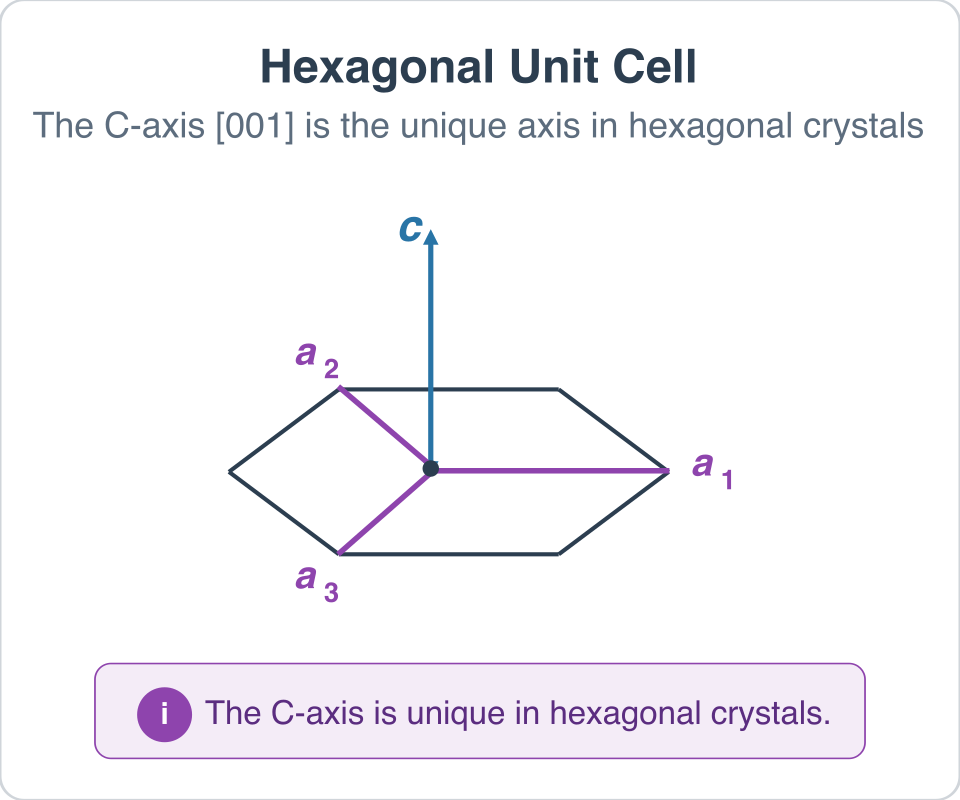
In hexagonal crystal structures (such as titanium, magnesium, and zinc), the C-axis is the unique crystallographic direction that runs along the long axis of the hexagonal unit cell (the [001] direction). This axis is important because many mechanical and physical properties of hexagonal materials vary depending on whether they are measured along or perpendicular to the C-axis.
How This Filter Works
Each Cell has a measured crystal orientation stored as a quaternion. This filter uses that orientation to rotate the crystal [001] direction into the physical sample coordinate system, producing a 3D unit vector that describes where the C-axis points.
The output vectors are normalized to unit length and constrained to the upper hemisphere (positive Z component) to provide a unique, unambiguous representation.
Hexagonal Materials Only
This filter only produces valid results for hexagonal phases (6/mmm or 6/m symmetry). In hexagonal materials, the C-axis is unique – there is only one [001] direction, so crystal symmetry does not create ambiguity.
In cubic materials, the [001], [010], and [100] directions are all crystallographically equivalent. Applying symmetry operators would move the [001] direction to different positions in the sample frame, making this computation ambiguous. For this reason, non-hexagonal phases will have their output values set to NaN.
Comparison with Compute Average C-Axis Orientations
This filter computes the C-axis direction for each individual Cell. If you need the average C-axis direction for each Feature (grain) instead, use the Compute Average C-Axis Orientations filter.
Required Input Sources
Cell Quaternions – typically read from EBSD data via Read H5EBSD, Read CTF Data, or Read ANG Data; can also be produced from Euler angles by Convert Orientations.
Cell Phases – typically read from EBSD data alongside the quaternions.
Crystal Structures – ensemble-level array read from EBSD data or created by Create Ensemble Info.
Input Cell Data
Parameter Name |
Parameter Type |
Parameter Notes |
Description |
|---|---|---|---|
Cell Quaternions |
Array Selection |
Allowed Types: float32 Comp. Shape: 4 |
DataPath to input quaternion values |
Cell Phases |
Array Selection |
Allowed Types: int32 Comp. Shape: 1 |
Specifies to which Ensemble each Cell belongs |
Input Ensemble Data
Parameter Name |
Parameter Type |
Parameter Notes |
Description |
|---|---|---|---|
Crystal Structures |
Array Selection |
Allowed Types: uint32 Comp. Shape: 1 |
Enumeration representing the crystal structure for each Ensemble |
Output Cell Data
Parameter Name |
Parameter Type |
Parameter Notes |
Description |
|---|---|---|---|
C-Axis Locations |
DataObjectName |
DataPath to calculated C-Axis locations |
Example Pipelines
EBSD_Hexagonal_Data_Analysis
License & Copyright
Please see the description file distributed with this Plugin
DREAM3D-NX Help
If you need help, need to file a bug report or want to request a new feature, please head over to the DREAM3DNX-Issues GitHub site where the community of DREAM3D-NX users can help answer your questions.