12.11. Compute Feature Reference Misorientations
Group (Subgroup)
Statistics (Crystallography)
Description
This Filter measures how much crystal orientation varies within each Feature (grain) by computing the misorientation angle between each Cell (voxel) and a chosen reference orientation for that Feature.
This is useful for detecting intragranular orientation gradients caused by plastic deformation, subgrain formation, or other processes that cause the crystal lattice to rotate within a grain.
Choosing a Reference Orientation
The user selects the reference orientation from two options. The choice depends on the physical question being asked:
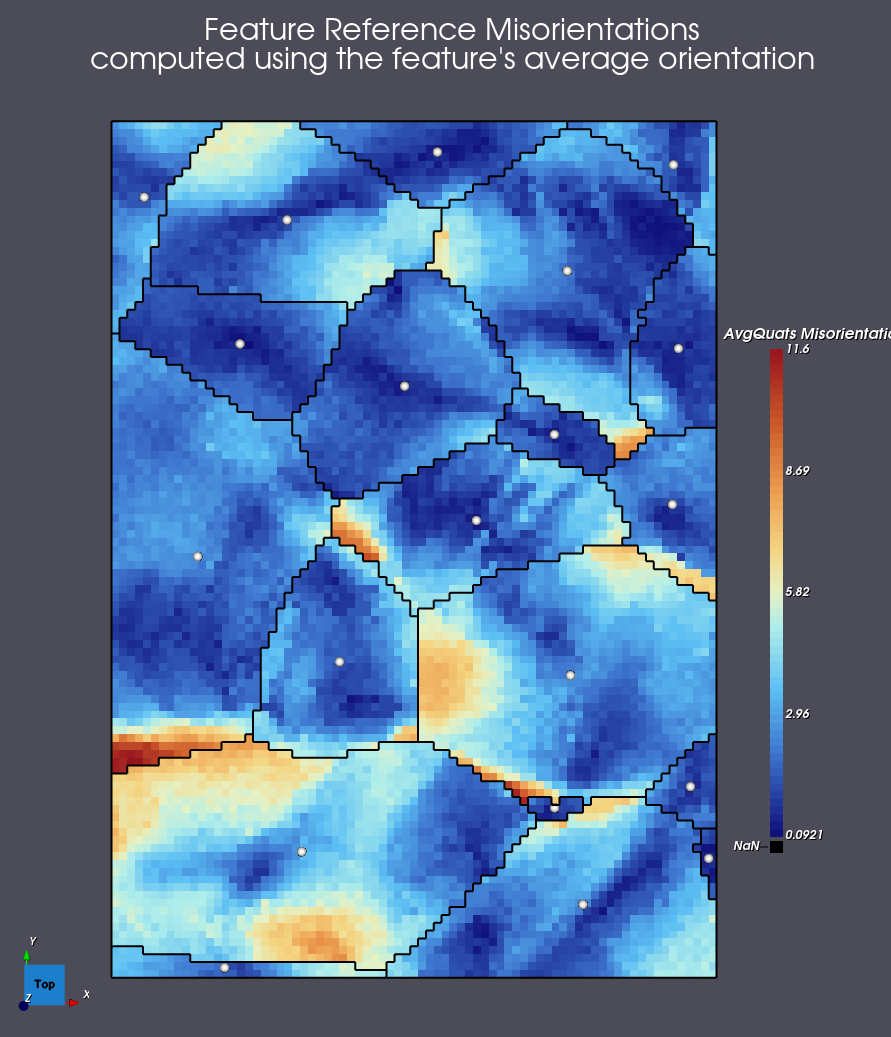
Average Feature Orientation – Uses the average orientation of all cells in the grain. This is the typical choice for characterizing overall orientation spread within a grain.
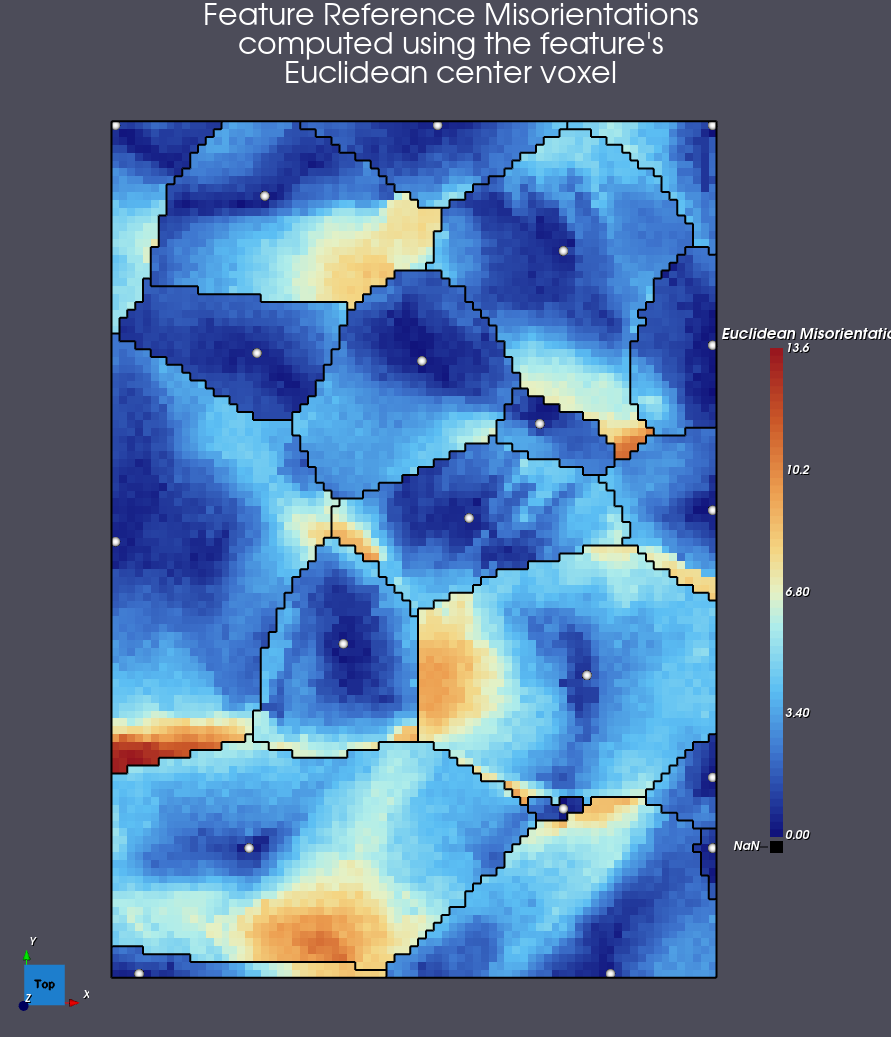
Orientation Farthest from Feature Boundary – Uses the orientation of the cell nearest to the Euclidean center of the grain (farthest from any boundary). If the grain has undergone plastic deformation, boundary regions tend to rotate more than the interior. Using the center cell as the reference provides a more stable baseline that better reveals the pattern of lattice rotation from the interior outward.
Reference Orientation
The Reference Orientation parameter provides the following choices:
Average Feature Orientation [0]: Uses the average orientation of the Feature as the reference orientation for misorientation calculations.
Orientation Farthest from Feature Boundary [1]: Uses the orientation of the Cell that is furthest from the boundary of the Feature (nearest to its Euclidean center) as the reference orientation. Requires a
Boundary Euclidean Distancesarray as input; that array is typically produced by the Compute Euclidean Distance Map filter upstream of this one.
Output Units
The misorientation values in both output arrays (Cell Reference Misorientations and Feature Average Misorientations) are expressed in degrees, not radians.
Mode 1 — Raster-order tie-break for the “farthest from boundary” voxel
When two or more voxels within a single feature share the same maximum Boundary Euclidean Distances value, the algorithm selects the voxel with the latest linear (raster) index as the feature’s reference. This matches the legacy DREAM3D 6.5.171 behavior. In practice, ties are rare on real EBSD data and the choice between tied voxels has no qualitative impact on the resulting misorientation field; for synthetic inputs that deliberately tie distances, the reader should be aware that re-ordering the voxel layout would change which voxel is selected as the reference.
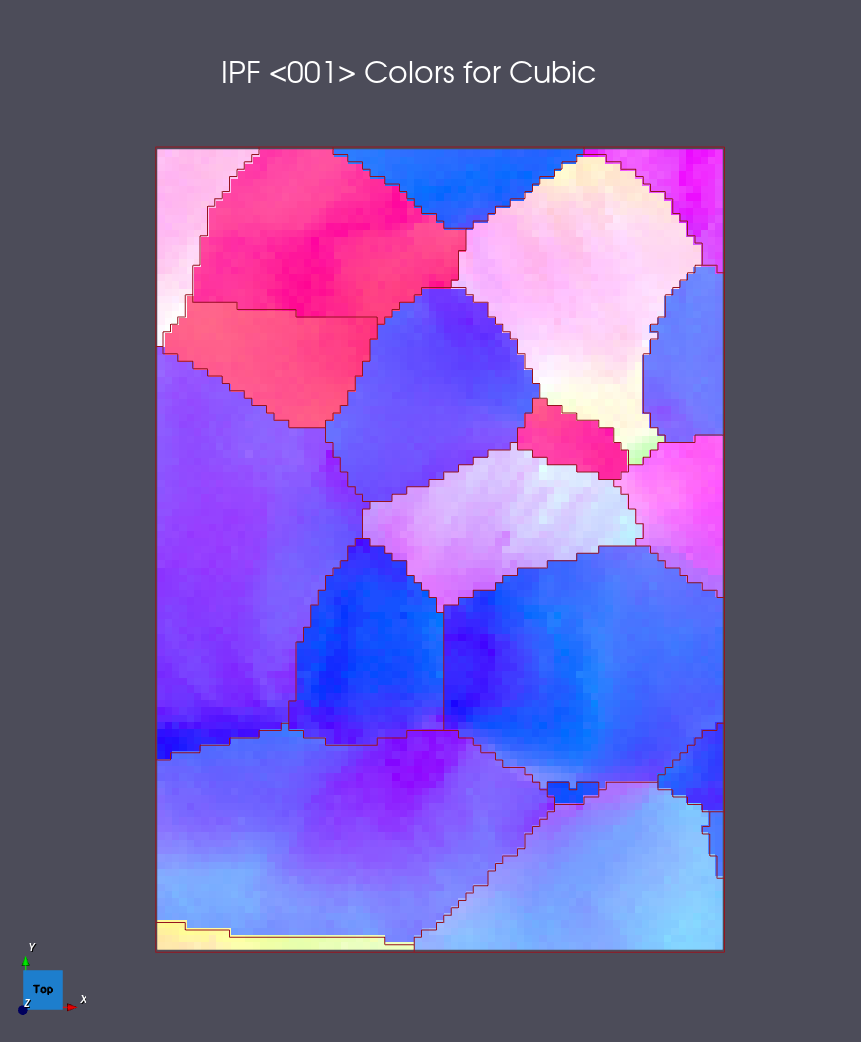
IPF Colors <001> Direction
This is the data set’s IPF colors by the <001> direction which shows the reader the relative orientation gradients within each feature (grain).
Example Using Feature’s Average Orientation
Using the T12-MAI-2010/fw-ar-IF1-aptr12-corr.ctf data set we can generate the following
data using the Feature Average Orientation choice.
Example Using Feature’s Euclidean Center Voxel’s Orientation
Using the same dataset, the algorithm will find the voxel that is the furthest from the feature boundary, and use that voxel’s orientation as the reference orientation.
Required Input Sources
Cell Feature Ids – produced by a segmentation filter such as Segment Features (Misorientation).
Cell Quaternions – typically read from EBSD data via Read H5EBSD, Read CTF Data, or Read ANG Data.
Cell Phases – typically read from EBSD data alongside the quaternions.
Average Quaternions (for Average Feature Orientation mode) – produced by Compute Average Orientations.
Boundary Euclidean Distances (for Orientation Farthest from Feature Boundary mode) – produced by Compute Euclidean Distance Map.
Crystal Structures – ensemble-level array read from EBSD data or created by Create Ensemble Info.
Input Parameter(s)
Parameter Name |
Parameter Type |
Parameter Notes |
Description |
|---|---|---|---|
Reference Orientation |
Choices |
Specifies the reference orientation to use when comparing to each Cell |
Input Cell Data
Parameter Name |
Parameter Type |
Parameter Notes |
Description |
|---|---|---|---|
Cell Feature Ids |
Array Selection |
Allowed Types: int32 Comp. Shape: 1 |
Specifies to which feature each cell belongs. |
Cell Phases |
Array Selection |
Allowed Types: int32 Comp. Shape: 1 |
Specifies to which Ensemble each Cell belongs |
Cell Quaternions |
Array Selection |
Allowed Types: float32 Comp. Shape: 4 |
Specifies the orientation of the Cell in quaternion representation |
Boundary Euclidean Distances |
Array Selection |
Allowed Types: float32 Comp. Shape: 1 |
Distance the Cells are from the boundary of the Feature they belong to. Only required if the reference orientation is selected to be the ‘Orientation Farthest from Feature Boundary’ |
Input Feature Data
Parameter Name |
Parameter Type |
Parameter Notes |
Description |
|---|---|---|---|
Average Quaternions |
Array Selection |
Allowed Types: float32 Comp. Shape: 4 |
Specifies the average orientation of the Feature in quaternion representation (, w). Only required if the reference orientation is selected to be the average of the Feature |
Feature Attribute Matrix |
AttributeMatrixSelection |
The path to the cell feature attribute matrix |
Input Ensemble Data
Parameter Name |
Parameter Type |
Parameter Notes |
Description |
|---|---|---|---|
Crystal Structures |
Array Selection |
Allowed Types: uint32 Comp. Shape: 1 |
Enumeration representing the crystal structure for each Ensemble |
Output Cell Data
Parameter Name |
Parameter Type |
Parameter Notes |
Description |
|---|---|---|---|
Cell Reference Misorientations |
DataObjectName |
The name of the array containing the misorientation angle (in degrees) between Cell’s orientation and the reference orientation of the Feature that owns that Cell |
Output Feature Data
Parameter Name |
Parameter Type |
Parameter Notes |
Description |
|---|---|---|---|
Feature Average Misorientations |
DataObjectName |
The name of the array containing the average of the Feature reference misorientation values for all of the Cells that belong to the Feature |
|
Feature Euclidean Centers |
DataObjectName |
The coordinate of the voxel that is used for the Euclidean based calculation |
Example Pipelines
(04) Small IN100 Crystallographic Statistics
License & Copyright
Please see the description file distributed with this Plugin
DREAM3D-NX Help
If you need help, need to file a bug report or want to request a new feature, please head over to the DREAM3DNX-Issues GitHub site where the community of DREAM3D-NX users can help answer your questions.