12.51. Write GBCD Pole Figure (GMT 5)
Group (Subgroup)
IO (Output)
Description
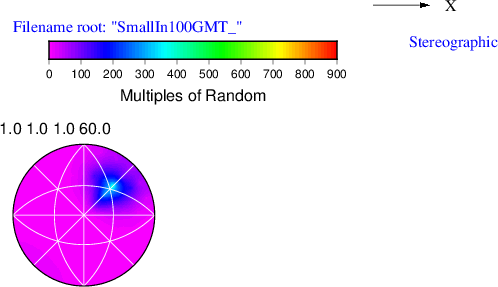
This filter exports a grain boundary character distribution (GBCD) as a plain-text .dat file that the external Generic Mapping Tools (GMT) package can render into a pole figure image. The filter does not draw the pole figure itself — it writes the data file that GMT then turns into a picture.
What is a GBCD Pole Figure?
A grain boundary is the internal interface where two grains (individual crystals) meet inside a material. The grain boundary character distribution (GBCD) measures how often boundaries of a particular crystallographic character occur, compared to what a completely random arrangement would produce.
For a chosen misorientation (the rotation that relates the crystal orientations of the two grains on either side of a boundary), the GBCD describes how the boundary-plane normals are distributed in space. That distribution is displayed on a pole figure: a 2D circular plot that maps 3D directions onto a disk. The plotted values are in multiples of a random distribution (MRD), where 1.0 means “as common as a random arrangement” and values above 1.0 mark boundary planes that occur more often than random.
What This Filter Does
This filter is one step in an external toolchain:
Compute GBCD → Write GBCD Pole Figure (GMT 5) → GMT → rendered pole figure
It samples the GBCD for the selected phase and misorientation and writes the result to a .dat text file. GMT (a separate, freely available command-line mapping toolkit) reads that file to produce the final image.
Parameter Guidance
Phase of Interest — the 1-based index of the Ensemble (phase) whose boundaries are plotted. A value of 1 selects the first real phase; index 0 is reserved for the unindexed/background ensemble. This value is a dimensionless index.
Misorientation Axis-Angle — selects which boundary misorientation to plot. The first value is the misorientation angle in degrees; the remaining three are the crystallographic axis (h, k, l), a dimensionless crystal direction. For example, 60° about (1, 1, 1) selects the Σ3 twin misorientation common in cubic materials.
Output GMT File — the path of the
.datfile to write. GMT reads this file to draw the pole figure.
Required Input Sources
GBCD – produced by Compute GBCD.
Crystal Structures – typically read from EBSD data via Read H5EBSD File, Read EDAX EBSD Data (.ang), or Read Oxford Instr. EBSD Data (.ctf).
Input Parameter(s)
Parameter Name |
Parameter Type |
Parameter Notes |
Description |
|---|---|---|---|
Phase of Interest |
Scalar Value |
Int32 |
Index of the Ensemble for which to plot the pole figure |
Misorientation Axis-Angle |
Vector of Float32 Values |
Order=Angle,h,k,l |
Axis-Angle pair values for drawing GBCD |
Output GMT File |
FileSystemPath |
The output .dat file path |
Input Triangle Ensemble Data
Parameter Name |
Parameter Type |
Parameter Notes |
Description |
|---|---|---|---|
GBCD |
Array Selection |
Allowed Types: float64 |
5 parameter GBCD data. The 6th component is used internally to track the northern vs. southern hemisphere of the Lambert sphere |
Crystal Structures |
Array Selection |
Allowed Types: uint32 Comp. Shape: 1 |
Enumeration representing the crystal structure for each Ensemble |
Example Pipelines
(08) Small IN100 GBCD
License & Copyright
Please see the description file distributed with this Plugin
DREAM3D-NX Help
If you need help, need to file a bug report or want to request a new feature, please head over to the DREAM3DNX-Issues GitHub site where the community of DREAM3D-NX users can help answer your questions.