12.23. Compute Neighbor Slip Transmission Metrics
Group (Subgroup)
Statistics (Crystallography)
Description
This Filter calculates a suite of slip transmission metrics for each pair of neighboring Features (grains). These metrics quantify how easily plastic deformation (slip) can transfer across a grain boundary from one grain to another, based on the geometric alignment of their slip systems.
When a material deforms, slip occurs along specific crystallographic planes and directions within each grain. At grain boundaries, slip in one grain must either transmit into the neighboring grain, be blocked, or nucleate new slip. The degree of geometric compatibility between the slip systems on each side of a boundary is a key factor in determining whether transmission occurs or whether stress concentrations develop that can lead to crack initiation.
Cubic Materials Only
This filter only works on cubic m-3m Laue classes.
How This Filter Works
For each Feature, the filter retrieves its average orientation and list of neighboring Features
For each neighbor pair, the filter evaluates all possible combinations of slip systems across the boundary
The transmission metrics are computed in both directions (Feature 1 → Feature 2 and Feature 2 → Feature 1) because the directionality affects the result
Results are stored as lists per Feature, one value per neighbor
Note
The metrics are calculated using the average orientations of neighboring grains, not the local orientations near the boundary.
Luster-Morris Parameter (M’)
The Luster-Morris parameter (M’) measures the geometric compatibility between two slip systems across a boundary. A value of 1.0 indicates perfect alignment; lower values indicate poorer compatibility. Calculated as presented in [1].
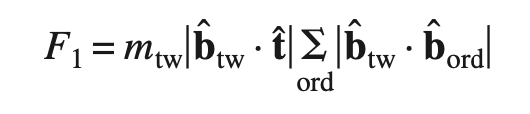
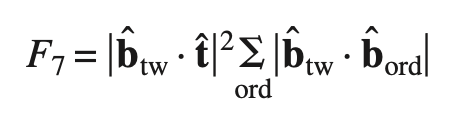
Fracture Initiation Parameters (F1, F1spt, F7)
Three fracture initiation parameter (fip) values are computed, which relate to the likelihood of crack nucleation at grain boundaries due to slip incompatibility. These are defined in [2] (see page 021012-4):

Comparison with Compute Feature Boundary Strength Metrics
This filter stores results per Feature (in neighbor lists). The Compute Feature Boundary Strength Metrics filter computes the same metrics but stores results per Face on a Triangle Geometry, which is useful for visualization on the boundary mesh.
Required Input Sources
Neighbor List – produced by Compute Feature Neighbors or Compute Feature Neighborhoods.
Average Quaternions – produced by Compute Average Orientations.
Feature Phases – produced by Compute Feature Phases.
Crystal Structures – ensemble-level array read from EBSD data or created by Create Ensemble Info.
References
Input Feature Data
Parameter Name |
Parameter Type |
Parameter Notes |
Description |
|---|---|---|---|
Average Quaternions |
Array Selection |
Allowed Types: float32 Comp. Shape: 4 |
Data Array that specifies the average orientation of each Feature as a quaternion |
Feature Phases |
Array Selection |
Allowed Types: int32 Comp. Shape: 1 |
Data Array that specifies to which Ensemble each Feature belongs |
Feature Neighbor List |
NeighborListSelection |
List of the contiguous neighboring Features for a given Feature |
Input Ensemble Data
Parameter Name |
Parameter Type |
Parameter Notes |
Description |
|---|---|---|---|
Crystal Structures |
Array Selection |
Allowed Types: uint32 Comp. Shape: 1 |
Enumeration representing the crystal structure for each phase |
Output Feature Data
Parameter Name |
Parameter Type |
Parameter Notes |
Description |
|---|---|---|---|
Luster-Morris M-Prime |
DataObjectName |
DataArray Name to store the calculated Luster-Morris Parameters |
|
Fracture Initiation Parameter (F1) |
DataObjectName |
DataArray Name to store the calculated F1 Values |
|
Fracture Initiation Parameter (F1spt) |
DataObjectName |
DataArray Name to store the calculated F1spt Values |
|
Fracture Initiation Parameter (F7) |
DataObjectName |
DataArray Name to store the calculated F7 Values |
Example Pipelines
License & Copyright
Please see the description file distributed with this Plugin
DREAM3D-NX Help
If you need help, need to file a bug report or want to request a new feature, please head over to the DREAM3DNX-Issues GitHub site where the community of DREAM3D-NX users can help answer your questions.